Cryptorchidism -
Undescended or Hidden Testicles
What is cryptorchidism?
The failure of the testicles (or “testes”) to descend into the scrotum (the skin sac below the penis) is called “cryptorchidism”. It is also called having hidden or undescended testicles. The condition is generally uncommon but often affects boys born prematurely.
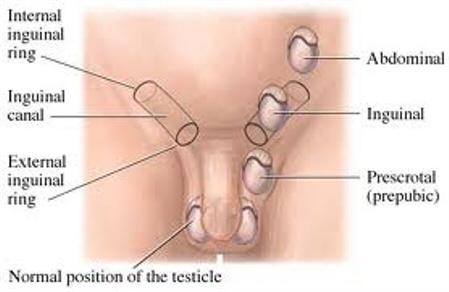
As a male foetus grows, the testicles appear in the abdomen near the kidneys. During the seventh month of development, the testicles start to descend to the groin. They should reach their final position in the scrotum by 6 months after birth.
The testicles make sperm and testosterone, the male sex hormone. An undescended testicle may produce hormones, but the ability to make sperm is disrupted.
At 1 year of age, nearly 1% of all full-term male infants have cryptorchidism. This is the most common birth defect of the sex organs in newborn male infants. Usually, only one testicle is affected, but both testicles are undescended in about 10% of children with cryptorchidism.
What causes cryptorchidism?
It is unknown why some testicles do not descend. Risk factors include:
• Family history of cryptorchidism or other genital development problems
• Premature birth or low birth weight
• Conditions that affect foetal growth
• The mother’s use of alcohol or cigarettes during pregnancy
• Previous exposure of either parent to certain pesticide
chemicals
Types of Cryptorchidism
Cryptorchidism is classified as “palpable” or “non-palpable”. A palpable undescended testicle can be felt on examination. A non-palpable testicle cannot be felt. Approximately 70% of all undescended testicles are palpable.
A palpable undescended testicle may have halted during a normal descent. Maybe the testicle grew in the wrong place and is outside of the scrotum (ectopic). Perhaps a muscle reflex causes the testicle move back and forth between the scrotum and the abdomen (retractile).
A non-palpable undescended testicle is located up inside
the abdomen. It may be above the genital organs
(inguinal ring), near a kidney, between the rectum ...
Urine Analysis
Kidney Stones
Bladder Problems
Prostate Disease
STD
Ureter